MGResearch notes & projects

Mingze Gao

MSc Biotechnology · National University of Singapore

Transcriptomics · Functional Genomics · Gene Regulation · Cardiovascular Disease

Projects in molecular prediction, enzyme-based sensing and transcriptomic analysis, with methods, selected results and work in progress.

Research interests

Research

Projects & notes

Notes on molecular prediction, experimental biosensing and an ongoing RNA-seq project.

Undergraduate thesis

Multimodal Bitter Compound Prediction

Reported accuracy
0.934
Reported AUC
0.978

A molecular classification workflow combining graph structure, mixed fingerprints and SMILES embeddings to predict bitter compounds. Feature combinations and prediction networks were compared to assess the contribution of each component.

Model overview
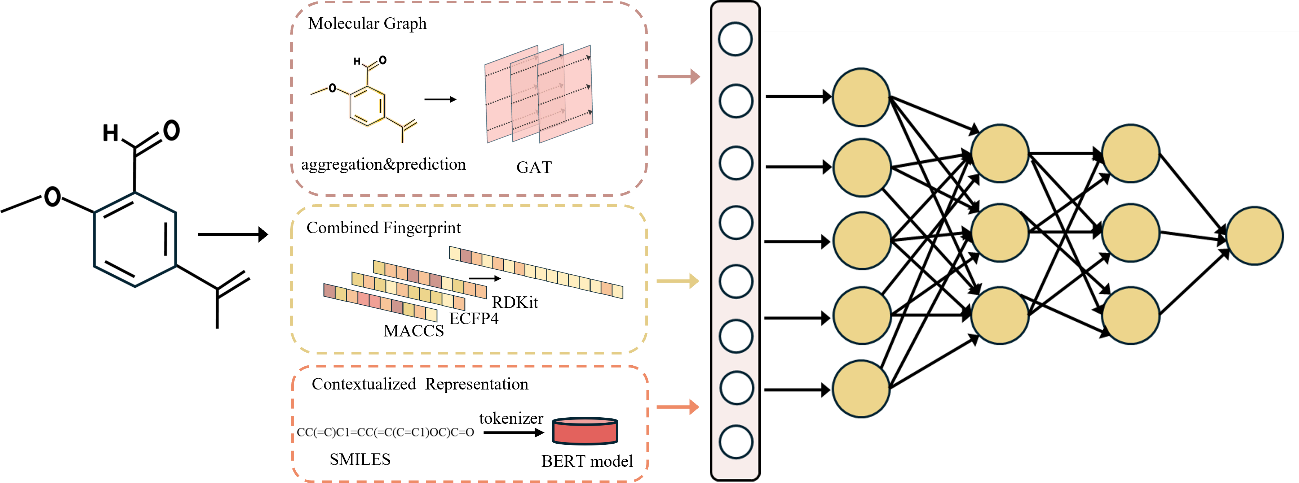
Original thesis model diagram showing molecular graph, mixed fingerprints and BERT SMILES branches feeding a prediction network.
Thesis Figure 2-2. Molecular graph, combined fingerprint and SMILES representations feed the multimodal prediction framework. View full size ↗

Data preparation

Taste labels were integrated from databases and literature. Ambiguous labels were filtered, and compounds were deduplicated using identifiers and canonical SMILES before molecular representations were generated.

Representation & fusion

A graph-attention network encodes molecular topology; MACCS, ECFP4 and RDKit fingerprints represent substructures; pretrained BERT encodes SMILES. Three 256-dimensional vectors are concatenated and projected into a fused representation for classification.

Implementation & evaluation

The Python workflow covers preprocessing, feature generation, model training and evaluation. Ablation experiments compare representation combinations, an additional attention module and alternative prediction classifiers.

Ablation experiments

Two components were varied separately: the molecular representations and the prediction network.

Feature combinations

Which inputs contribute to prediction? Single representations and pairwise combinations were compared with the complete model.

Accuracy by feature combination: graph 0.751, fingerprints 0.928, SMILES 0.916, graph and fingerprints 0.925, graph and SMILES 0.914, fingerprints and SMILES 0.928, all three 0.934.
Mean accuracy redrawn from thesis Table 3-2. The original table also reports variability; this summary shows means only. View full size ↗

Fingerprints were the strongest single representation. All three inputs gave the highest reported accuracy; adding graph features to either single branch did not consistently improve performance.

Prediction network

Which classifier works with the learned representations? RF, SVM, KNN and XGB variants were compared with the thesis prediction network.
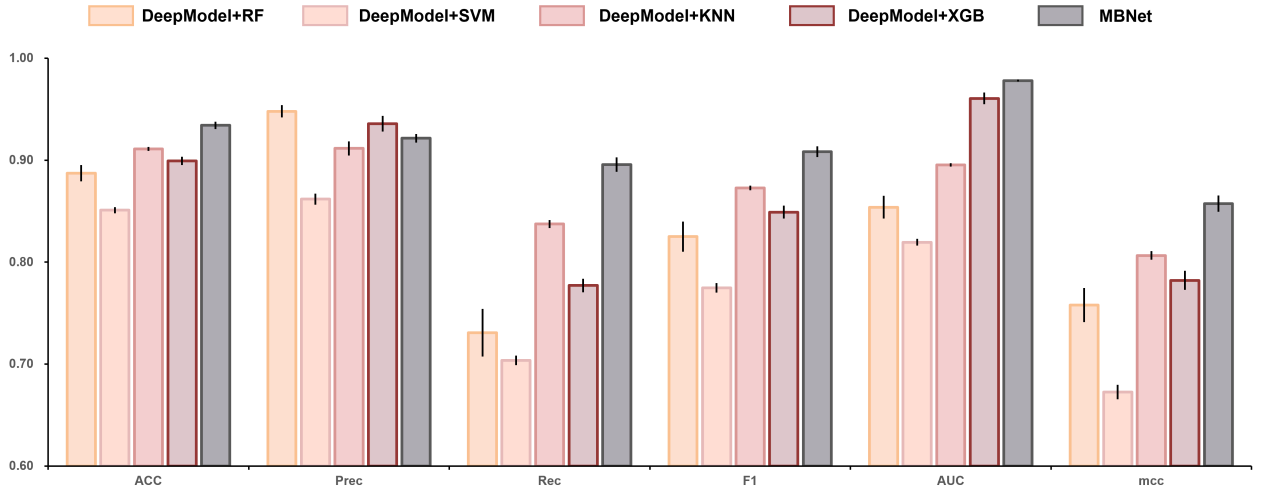
Original thesis grouped bar chart comparing RF, SVM, KNN, XGB and this study across classification metrics.
Thesis Figure 3-2. Comparison with RF, SVM, KNN and XGB prediction variants under the thesis evaluation setup. View full size ↗

The thesis model reported accuracy of 0.934 and AUC of 0.978. The comparison evaluates the downstream prediction stage within the thesis setup.

Evaluation notes

The thesis assessed the multimodal model using train/validation/test partitioning and repeated evaluation, reporting accuracy of 0.934 and AUC of 0.978. Ablation comparisons explored the roles of molecular representations and downstream classifiers. These figures are presented as results reported in the undergraduate thesis.

Experimental project

Histamine Nanozyme Biosensor

A proposed co-assembly of diamine oxidase (DAO) and Fe-GMP coordination polymer nanoparticles, combining substrate conversion and color generation within one scaffold.

DAO@Fe-GMP: a proposed cascade assembly

HistamineSubstrate

Fe-GMP coordination network

DAOEnzyme incorporated
during co-assembly

Histamine → H₂O₂ → TMB oxidation

Conversion + color readout in one scaffold
Color signalIntended output
Conceptual schematic of the proposed DAO@Fe-GMP architecture, illustrating the intended integration of substrate conversion and colorimetric readout. Experimental findings and optimization are discussed below.

Architecture rationale

DAO converts histamine into H₂O₂. Fe-GMP supplies peroxidase-like activity for the TMB color readout while providing a network for enzyme incorporation. Co-assembly was intended to connect the two catalytic steps in a single material.

Experimental work

Fe-GMP particles were prepared and their peroxidase-like activity was verified, with a linear H₂O₂ response over 0–200 μM. The experimental work included material preparation, catalytic activity assays and systematic troubleshooting.

Experimental findings

Fe-GMP showed a measurable H₂O₂-dependent colorimetric response. In the coupled DAO–histamine system, the response remained limited under the tested conditions; direct H₂O₂ controls helped identify the upstream conversion step as a key target for optimization.

Experimental troubleshooting & optimization

The coupled reaction brought together two catalytic components with different preferred conditions: DAO operated closer to neutral pH, whereas Fe-GMP showed stronger peroxidase-like activity under acidic conditions. Troubleshooting therefore focused on reconciling these requirements through staged reactions and pH adjustment, while examining incubation time, temperature, and enzyme and substrate concentrations.

Direct H₂O₂ addition served as a control for the downstream Fe-GMP/TMB color reaction and produced a clear response. Comparing this control with the DAO–histamine cascade helped narrow the optimization focus to the upstream H₂O₂-generation step and its compatibility with the coupled reaction conditions.

These experiments informed subsequent optimization priorities, particularly reaction sequencing, pH compatibility and preservation of enzyme activity during assembly. A reproducible histamine-dependent response remains a goal for further development.

Research trainingIn progressRNA-seq · hiPSC-derived cardiac organoids

Cardiac Fibrosis RNA-seq

Reproducible RNA-seq Analysis of Fibrotic Remodeling and FGFR1 Inhibition in hiPSC-Derived Cardiac Organoids

Ongoing research training in reproducible RNA-seq analysis, focusing on study design, donor/background effects and traceable analysis decisions.

Scientific question, planned workflow & analysis decisions

Independent software project · Windows

ReadLayer

A transparent desktop reading layer for TXT documents, presentation notes and recorded explanations.

Built with C# and WinUI, with adjustable typography, line spacing, colours and scrolling speed. The reading layer stays above the working window; a shortcut switches between controlling the script and interacting with the application underneath.

PresentationsRecorded explanationsContinuous TXT reading

Control the script

In control mode, Space pauses or resumes the text. Hold ↑ to speed up or ↓ to slow down. The reading window can be moved, resized and scrolled.

Work through the layer

Switch out of control mode with Ctrl + Shift + X. Mouse input passes through the layer and the reading-control keyboard hook is released, so the focused application can receive normal input while the script stays visible.

One shortcut, two modes

Watch ReadLayer switch between controlling the scrolling text and interacting with PowerPoint, using Ctrl + Shift + X.

34-second silent Windows recording · Two brief mode indicators are built into the video.

Controls & usage guide

Open a TXT file

Select 打开 TXT (Open TXT), choose the script, adjust its appearance and scrolling speed, then select 启动 (Start).

Download example script (.txt) ↗

Switch modes

Ctrl + Shift + X toggles control mode. In control mode, Space toggles playback; holding ↑ or ↓ temporarily changes the speed. Outside control mode, click the underlying application to focus it before using its keyboard controls.

Read alongside other work

Match text colour and background opacity to the material underneath. Use the same scrolling reader for long TXT documents. Ctrl + Shift + Q closes the reading layer.

Methods

Computational & experimental work

Completed work includes molecular representation learning in Python, nanoparticle preparation, enzyme-activity assays and experimental controls.

Ongoing work focuses on reproducible RNA-seq analysis using R and Bioconductor, including study design, data processing and interpretation.

Contact

Get in touch

MSc Biotechnology · National University of Singapore

Additional ablation experiment

Attention-module exploration

Rationale

An additional attention module was tested to examine whether learned feature weighting could improve prediction beyond the existing projection and fusion layers. The comparison concerned this extra module; the graph-attention encoder remained part of the molecular graph branch.

Comparison

The thesis compared configurations with (ATT) and without (no_ATT) the additional module across accuracy, precision, recall, F1, balanced accuracy, AUC, MCC, kappa and average precision.

Original attention ablation chart comparing ATT and no_ATT across nine classification metrics.
Original thesis Figure 3-1; values reported in Table 3-3. Error bars are retained from the original figure.

Observed result

Reported accuracy was 0.930 with ATT and 0.934 without it; AUC was 0.977 and 0.978, respectively. The added module did not improve the reported metrics, and the no_ATT configuration was retained.

Interpretation

The experiment tested whether the extra complexity was useful for this task. One possible explanation is that reweighting did not add useful information beyond the existing representations and projections. The comparison alone does not establish that mechanism, statistical significance, or a general limitation of attention.

The result supports the simpler configuration under the reported setup. Confirmation would require matched splits and training settings, repeated runs and examination of the learned feature weights.